What is Supply Chain and Logistics Management? A Complete Guide for Businesses
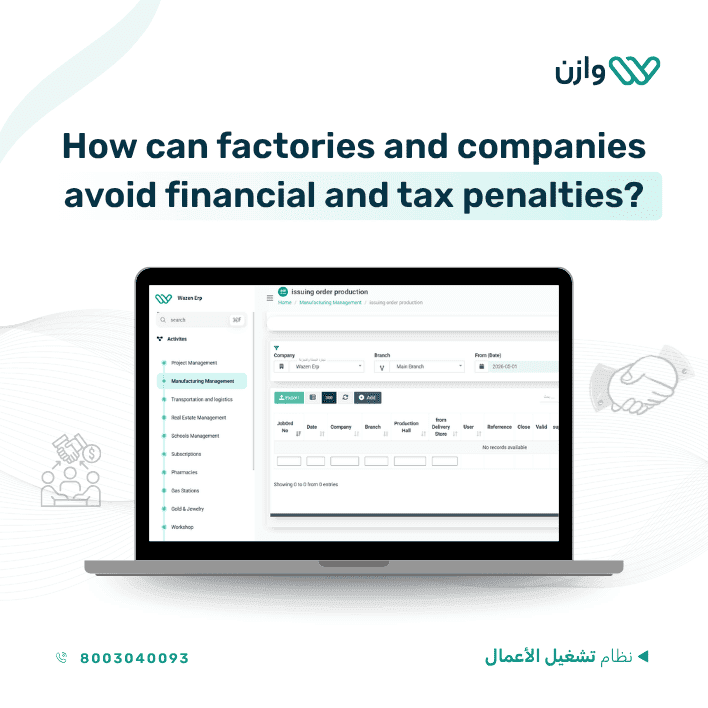
How can factories and companies avoid financial and tax penalties? This has become a fundamental question in light of the constant changes in financial and tax regulations and the tightening of oversight regarding accounting compliance across various sectors. Managing financial obligations correctly is no longer merely an administrative procedure; it has become a critical element in the stability of companies and the continuity of their growth without exposure to the risks of fines or sanctions.
Avoiding these penalties relies on a set of precise practices, such as organizing accounting records, committing to submitting tax returns on time, and implementing accurate financial systems that help monitor operations in real-time. This reduces errors and ensures that operations align with approved regulations. Furthermore, integrating these financial practices with effective supply chain management ensures that every transaction is accounted for from production to delivery.
Financial and Tax Penalties🔗
Financial and tax penalties are among the most prominent challenges facing factories and companies. They often result from accounting errors, delays in submitting returns, or non-compliance with applicable systems and regulations. With the increase in financial legislation and the complexity of procedures, it has become essential for institutions to adopt precise management methods to avoid these risks and ensure full compliance.
Reducing these penalties depends on implementing clear organizational practices, which makes the topic of how can factories and companies avoid financial and tax penalties? a major focal point for every entity seeking financial stability.
Among the most prominent of these practices are:
- Commitment to the specified deadlines for submitting tax returns regularly and accurately.
- Using modern accounting systems that reduce human error and ensure data accuracy.
- Documenting all financial operations in an organized manner that is easy to reference when needed.
- Conducting periodic audits of accounts to ensure there are no violations or accounting discrepancies.
- Continuously training financial staff on modern tax systems and regulations.
- Seeking assistance from accounting experts to ensure full compliance with approved systems.
Consequently, the effective application of these procedures helps companies and factories avoid financial and tax penalties and enhances the efficiency of financial management and long-term business stability.
How Can Factories and Companies Avoid Financial and Tax Penalties?🔗
Factories and companies can reduce exposure to financial and tax penalties by implementing an organized administrative and financial system that ensures full compliance with laws and regulations. This involves constant, precise monitoring of all accounting operations to avoid errors or delays that could lead to financial violations. In a broader sense, this transparency is vital for logistics and supply chain management, as financial discrepancies can disrupt the flow of goods and services.
Achieving this relies on a set of essential procedures, including:
- Strict commitment to tax return submission deadlines without delay to ensure no late-payment fines are imposed.
- Implementing modern electronic accounting systems, such as the Wazen System, which help record financial transactions accurately and in real-time.
- Conducting periodic account reviews to verify data integrity and discover any errors before submitting official reports.
- Documenting all invoices and financial transactions in an organized way that facilitates the auditing and review process.
- Training the financial team on tax laws and continuous updates in financial systems.
- Consulting with financial advisors or specialized accountants to ensure full compliance with approved systems.
- Preparing periodic financial reports that help management make correct decisions and avoid potential risks.
- Continuously monitoring cash flows to prevent any imbalances that might lead to accounting or tax violations.
The Role of the Wazen System in Enhancing Tax Compliance and Reducing Accounting Errors🔗
The Wazen System contributes to raising the efficiency of financial management within factories and companies by providing a precise and organized accounting environment. This helps in adhering to tax regulations and reducing errors that could lead to financial fines, which is directly linked to the concept of how can factories and companies avoid financial and tax penalties? by relying on smart systems to manage financial operations. Such supply chain solutions are essential for modernizing the industrial financial infrastructure.
The role of the Wazen System in enhancing tax compliance and reducing accounting errors is evident through several key aspects:
- Automatically and accurately organizing financial records, which reduces the chances of data loss or incorrect entry.
- Real-time monitoring of accounting operations, helping to detect errors before they turn into financial violations.
- Facilitating the preparation of tax reports and returns with high accuracy and in accordance with regulatory requirements.
- Unifying financial data within a single system, reducing fragmentation and increasing audit efficiency.
- Reducing reliance on manual operations, which are among the most common sources of accounting errors.
- Providing an internal control system that helps management monitor financial performance continuously.
- Supporting tax compliance by automatically organizing operations according to approved regulations.
- Improving the management of invoices and expenses, ensuring the accuracy of final financial accounts.
- Enhancing the speed of financial decision-making based on accurate and constantly updated data.
How the Wazen System Helps in Organizing Financial Records and Professional Documentation🔗
The Wazen System contributes to raising the efficiency of managing financial records within factories and companies by providing an integrated digital system. This ensures that all financial operations are documented in an organized and precise manner, supporting the goal of avoiding penalties by improving the quality of accounting data.
This is achieved through several essential mechanisms:
- Automatically recording all financial transactions within a unified system to reduce fragmentation and duplication.
- Digitally documenting invoices, expenses, and revenues, making them easy to retrieve at any time.
- Organizing financial data within clear categories that assist in rapid access and review.
- Reducing reliance on manual entry, thereby decreasing the likelihood of human error.
- Securing and organizing records to ensure that important financial data is not lost.
- Linking all financial departments within a single platform to facilitate comprehensive monitoring of operations.
- Providing accurate reports that immediately reflect the true financial status of the factory or company.
Reducing Financial Risks Through Real-Time Data Review Using the Wazen System🔗
The Wazen System helps reduce financial risks within companies and factories by enabling real-time review of financial data. This gives management a greater ability to discover errors as they occur and take corrective actions quickly—a vital element in logistics optimization.
This is executed through a set of operational advantages, including:
- Direct, moment-by-moment monitoring of all financial operations without delay.
- Detecting accounting errors immediately before they accumulate or turn into larger problems.
- Providing instant notifications and alerts when any discrepancy in financial data is found.
- Enabling management to review financial reports in real-time to make accurate decisions.
- Reducing risks resulting from delays in discovering accounting or tax errors.
- Improving internal financial control through continuous monitoring of all operations.
- Supporting financial transparency within the institution by displaying accurate and constantly updated data.
How the Wazen System Helps Achieve Full Compliance with Tax Regulations🔗
The Wazen System enables factories and companies to achieve full compliance with tax regulations by organizing financial operations and linking them to precise accounting procedures that meet legal requirements. This directly supports the institution's ability to remain compliant and avoid the heavy hand of the law.
Its role in achieving tax compliance is shown through several key points:
- Applying organized accounting standards that ensure financial data aligns with approved tax systems.
- Preparing accurate financial reports that assist in submitting tax returns correctly and on time.
- Reducing accounting errors that might lead to violations or financial fines.
- Electronically documenting all financial operations to facilitate the auditing and review process.
- Providing a continuous monitoring system that ensures adherence to all updates in tax laws.
- Linking financial operations within a single system to reduce dispersion and increase data accuracy.
- Supporting financial transparency within the institution, which facilitates tax examination processes.
Why the Wazen System is an Ideal Choice to Avoid Financial and Tax Penalties🔗
The Wazen System is one of the ideal solutions that factories and companies rely on to avoid financial and tax penalties because it provides an integrated system for managing financial operations with high precision. This minimizes errors and fosters a culture of compliance.
Several factors make the Wazen System a suitable choice, including:
- Reducing human error in accounting processes through full automation.
- Improving the accuracy of financial data, which is reflected in the correctness of tax returns.
- Facilitating a quick and organized internal audit and review process.
- Providing a comprehensive financial vision that helps management make sound decisions.
- Supporting continuous compliance with regulations without the need for complex interventions.
- Reducing the time and effort spent on preparing financial reports.
- Enhancing operational efficiency within financial and accounting departments.
- Decreasing the likelihood of committing violations that could lead to financial or tax fines.
How can factories and companies avoid financial and tax penalties? This question represents a core focus for every institution seeking financial stability and a reduction in operational risks. Compliance with financial and tax regulations is no longer an option but a necessity to ensure business continuity with high efficiency and transparency. With the evolution of digital solutions like the Wazen System, managing financial operations with greater accuracy and reducing errors has become easier than ever.
Frequently Asked Questions (FAQ)🔗
What are the conditions for exemption from corporate tax penalties?🔗
The conditions for exemption from corporate tax penalties are determined according to the systems and regulations in force within each country. Tax authorities aim to achieve fairness and consider unintentional cases or those resulting from circumstances beyond control. The most prominent conditions include:
- The existence of a justified and proven reason for the delay or tax error.
- Submitting the exemption request within the time period specified by the competent authority.
- Correcting the tax status and submitting the return or data correctly.
- The absence of deliberate intent to evade or circumvent taxes.
- Commitment to paying the original tax due in the event a partial exemption request is accepted.
- The violation must not be a repeated or intentional occurrence.
What are some examples of tax avoidance?🔗
Tax avoidance refers to the use of available legal means to reduce tax liabilities without violating the law, through proper financial planning and benefiting from systemic incentives and exemptions. Notable examples include:
- Benefiting from tax exemptions granted to certain activities or sectors.
- Legally restructuring a business to reduce the tax burden.
- Taking advantage of legally permitted tax deductions.
- Distributing profits according to legal mechanisms that reduce taxes due.
- Choosing the appropriate timing for executing certain financial transactions.
- Investing in regions or sectors that enjoy tax incentives.
What is the difference between tax avoidance and tax evasion?🔗
Tax avoidance differs clearly from tax evasion in terms of legality and commitment. One is considered a legitimate practice, while the other is a violation punishable by law.
- Tax Avoidance: Using legitimate legal methods to reduce the value of taxes due without violating regulations. It relies on financial planning and utilizing available exemptions.
- Tax Evasion: An illegal method based on hiding income or providing incorrect financial data. It includes non-disclosure of revenues or manipulation of financial records.
- Consequences: Tax evasion leads to the imposition of strict financial fines and legal penalties.
احجز عرض توضيحي الآن!
تعرّف أكثر على حلول وازن ERP المتكاملة لتشغيل الأعمال، واكتشف مستقبل الحوكمة الرقمية
معتمد من هيئة الزكاة والضريبة والجمارك
معتمد كمزود خدمة تخطيط موارد المؤسسات "لمصانع المستقبل"
دعم فني في استيراد بيانات نظامك السابق
قابل للربط والتخصيص والتكامل
معتمد من هيئة الزكاة والضريبة والجمارك
معتمد كمزود خدمة تخطيط موارد المؤسسات "لمصانع المستقبل"
دعم فني في استيراد بيانات نظامك السابق
قابل للربط والتخصيص والتكامل
معتمد من هيئة الزكاة والضريبة والجمارك
معتمد كمزود خدمة تخطيط موارد المؤسسات "لمصانع المستقبل"
دعم فني في استيراد بيانات نظامك السابق
قابل للربط والتخصيص والتكامل
معتمد من هيئة الزكاة والضريبة والجمارك
معتمد كمزود خدمة تخطيط موارد المؤسسات "لمصانع المستقبل"
دعم فني في استيراد بيانات نظامك السابق
قابل للربط والتخصيص والتكامل
Related Posts
- Read
Steps to Register for the Future Factories Initiative
The steps to register for the Future Factories Initiative represent the primary gateway for factories seeking to benefit from support and de
- Read
The Difference Between Manufacturing and Production
The difference between manufacturing and production is a fundamental concept in industry and operations management. Many business owners oft
- Read
Smart Factories Guide for Modern Manufacturing
Smart factories have become the cornerstone of the future of the industrial sector, as they rely on advanced digital technologies to connect
- Read
Logistics vs Supply Chain Management: Key Differences Explained Simply
Corporate and factory compliance and governance in Saudi Arabia represents the cornerstone of ensuring business sustainability and achieving