How to Optimize Manufacturing Efficiency and Boost Factory Productivity in 2026
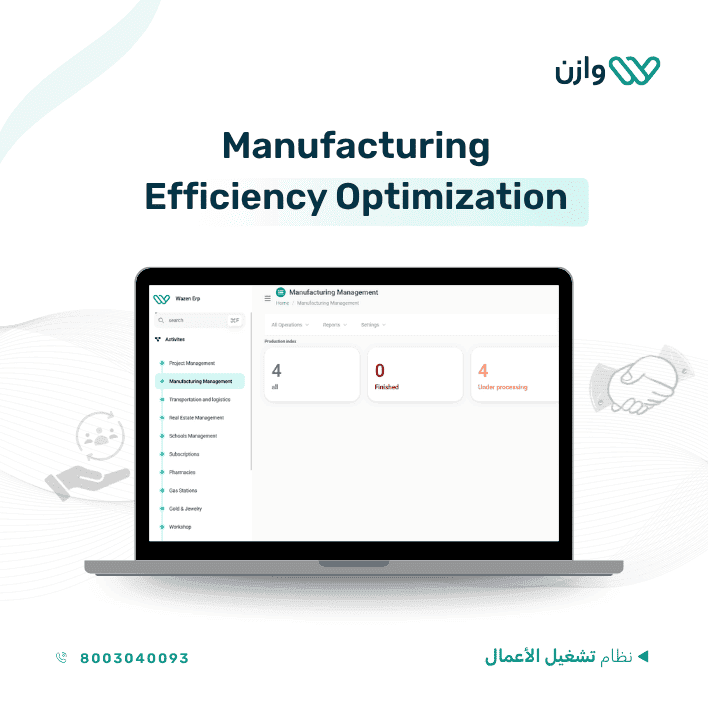
Manufacturing efficiency optimization represents the cornerstone for any industrial facility aspiring to achieve growth and enhance its competitiveness in a rapidly changing market. With increasing pressures related to production costs, supply chain complexities, and the need to enhance product quality, it has become essential to adopt smart solutions that help regulate operations and maximize the utilization of available resources. This process is not limited to reducing waste or accelerating production; it extends to improving data accuracy, developing monitoring mechanisms, and raising the efficiency of administrative decision-making.
In this context, the Wazen System emerges as an integrated solution that effectively contributes to enhancing institutional efficiency by providing advanced tools for managing industrial and financial operations simultaneously. It works on automating daily procedures, organizing inventory movement, and precisely monitoring production lines, while also providing comprehensive analytical reports that help decision-makers understand performance and identify areas for improvement.
The Concept of Manufacturing Efficiency Optimization🔗
Manufacturing efficiency optimization is a strategic process aimed at raising the level of operational performance within industrial facilities by utilizing available resources in the best possible way. It focuses on reducing waste in time, costs, and materials while maintaining or improving the quality of the final product.
This concept relies on developing all elements of the production process—from planning and management to execution, monitoring, and continuous analysis of results. Enhancing factory efficiency is based on a set of core pillars that ensure tangible results, most notably:
- Process Automation: To reduce reliance on human intervention.
- Inventory Management Improvement: To avoid stockpiling or shortages.
- Enhancing Data Accuracy: To make decisions based on realistic information.
It also includes improving workforce performance through continuous training, applying quality standards, and using advanced technical systems that allow for real-time performance monitoring. This process is not restricted to the production side; it extends to administrative and financial aspects, contributing to cost regulation, cash flow improvement, and increased capacity for expansion and growth. With digital evolution, smart industrial efficiency solutions like ERP systems have become an essential element in achieving this goal, providing a comprehensive and integrated view of all operations within the factory.
Advantages of Smart Factory Management🔗
The advantages of smart management are among the most important factors supporting factory performance improvement. This approach relies on advanced digital technologies that allow for monitoring performance, analyzing data, and making decisions based on real-time information, which contributes to reducing errors and raising productivity. Key benefits include:
- Full Automation of Operational Processes: Reducing reliance on human intervention, limiting repetitive errors, and contributing to manufacturing efficiency optimization.
- Providing Accurate Real-time Data: Assisting in the rapid discovery of problems and immediate decision-making.
- Improving Inventory Management: Precisely tracking raw materials and products to reduce waste or overstocking.
- Enhancing Resource Efficiency: Both human and material, to achieve maximum productivity at the lowest possible cost.
- Boosting Product Quality: Through the application of precise and continuous control systems at all production stages.
- Supporting Decision-making: Via advanced analytical reports that help management set effective strategies.
- Reducing Operational Costs: By improving workflows and reducing waste in time and materials.
- Improving Communication: Between different departments within the factory, ensuring integrated operations and smooth execution.
- Predictive Maintenance: The ability to forecast malfunctions and problems before they occur using smart analytics.
- Supporting Expansion and Growth: Through flexible, scalable systems that suit the factory's future needs.
How to Plan Industrial Processes🔗
Planning industrial processes relies on setting a clear vision and a precise methodology to organize all production stages. This ensures manufacturing efficiency optimization and guarantees the best use of resources. Planning begins with studying actual market needs and analyzing available capabilities, then building an integrated system that links raw materials, labor, and production lines with clear goals for each stage.
This is achieved through:
- Market Demand Analysis: To determine the appropriate production volume and avoid surplus or deficit.
- Resource Study: Analyzing available raw materials, labor, and equipment to ensure high-efficiency usage.
- Workflow Mapping: Designing an organized flow chart for production processes that clarifies every manufacturing stage.
- Defining Roles and Responsibilities: For each department to ensure clarity of tasks and reduce overlap.
- Precise Scheduling: Preparing accurate timelines for executing production operations to ensure commitment to deadlines.
- Quality Standard Application: In all production stages to maintain a consistent level of performance.
- Using Modern Technical Systems: To follow up on workflow and analyze performance in real-time.
- Optimizing Inventory Management: To ensure material availability without shortages that affect production.
- Continuous Performance Monitoring: To identify weaknesses and improve factory productivity.
- Contingency Planning: Developing alternative plans to face any sudden breakdowns or issues to ensure continuity.
How to Reduce Waste in Factories🔗
Reducing waste is a fundamental pillar of manufacturing efficiency optimization. It contributes directly to lowering costs, increasing productivity, and improving product quality. This process relies on applying modern administrative and operational methods within the "Factory Management Cycle," which aims to monitor and analyze all production stages to discover and address sources of loss effectively.
This includes:
- Analyzing Production Stages: Identifying sources of waste in materials, time, or effort.
- Applying Strict Control Systems: Within the management cycle to monitor performance and reduce errors.
- Improving Inventory Management: To avoid damage or excessive storage that leads to financial losses.
- Continuous Workforce Training: On best operational practices to reduce human error.
- Using Automation Technologies: To reduce reliance on manual processes and error rates.
- Improving Production Planning: Ensuring the reduction of unplanned downtimes and time waste.
- Recycling Industrial Waste: Reusing recyclable materials to lower loss and increase utility.
- Periodic Equipment Maintenance: To avoid sudden malfunctions that halt production.
- Improving Raw Material Quality: To reduce the percentage of defective products.
- Relying on Data and Analytics: To make precise decisions that support industrial efficiency solutions.
How to Manage Factory Resources Efficiently🔗
Efficient resource management depends on achieving the perfect balance between using available resources and maximizing productivity. This ensures manufacturing efficiency optimization and reduces operational costs without affecting product quality. This process includes the integrated management of human resources, raw materials, equipment, and time within a smart administrative system.
Resources can be managed efficiently through:
- Accurate Needs Analysis: Determining the factory's resource requirements to avoid waste or shortages.
- Human Resource Distribution: Assigning staff based on skills and expertise to ensure the highest possible productivity.
- Raw Material Optimization: Through proper storage and continuous tracking to reduce loss.
- Using Advanced Technology: Utilizing systems that support how to manage factories efficiently and monitor performance in real-time.
- Production Scheduling: Ensuring maximum time utilization and reducing downtime.
- Periodic Maintenance: Keeping equipment efficient and reducing sudden breakdowns.
- Operational Cost Reduction: Improving the consumption of energy and various resources.
- Best Practice Training: Ensuring employees make optimal use of available resources.
- Performance Tracking: Using analytical reports to continuously improve factory productivity.
- Applying Flexible Strategies: Allowing adaptation to market changes and production needs.
What are Industrial KPIs and How to Measure Them🔗
Industrial Key Performance Indicators (KPIs) are essential tools that factories rely on to measure the efficiency of production processes and the achievement of operational goals. These indicators provide a clear picture of factory performance in various aspects such as production, quality, costs, and time.
Adopting these indicators contributes directly to manufacturing efficiency optimization, as they enable management to discover weaknesses, enhance strengths, and make strategic decisions based on accurate, realistic data. When industrial KPIs and their measurement methods are understood correctly, it becomes easier to develop processes and achieve better results continuously.
Industrial KPIs include a wide range of metrics such as:
- Production Rate.
- Waste Ratio.
- Overall Equipment Effectiveness (OEE).
- Product Quality.
- Cycle Time.
These are interconnected elements that reflect the true performance of the factory. By monitoring these indicators periodically, progress toward goals can be determined.
How to Measure Industrial KPIs
Measuring industrial KPIs relies on systematically collecting and analyzing data to ensure reliable results that support factory performance improvement. This is done through:
- Selecting Appropriate Indicators: Aligning them with strategic and operational goals.
- Continuous Data Collection: From various departments like production, inventory, and maintenance.
- Using Digital Systems: To analyze data and transform it into clear, easy-to-understand reports.
- Benchmarking: Comparing actual results against targets to identify performance gaps.
- Periodic Monitoring: To ensure continuity in manufacturing efficiency optimization.
- Deviation Analysis: Identifying the causes of variances and taking immediate corrective actions.
- Strategic Alignment: Linking KPIs to strategic goals for tangible results.
- Interactive Dashboards: Displaying real-time and accurate data.
- Team Training: Ensuring teams understand how to handle indicators effectively.
- Continuous Indicator Development: To keep pace with changes in the industrial environment.
The Factory Management Cycle🔗
The factory management cycle is a pivotal element in ensuring the continuity of production operations with high efficiency. Management is responsible for organizing and coordinating all resources within the factory to achieve maximum productivity at the lowest cost. Here, modern systems like Wazen play a role in developing operational performance and raising the level of control over all production stages, directly supporting waste reduction and administrative decision-making.
The role of the Wazen System in manufacturing efficiency optimization is evident in the following points:
- Organizing production operations to ensure an efficient and smooth workflow.
- Monitoring production line performance in real-time to ensure factory performance improvement.
- Analyzing operational and financial data to make precise decisions.
- Improving resource management and reducing loss.
- Quality control at all production stages to ensure products meet required standards.
- Developing flexible operational plans that suit changing market needs.
- Enhancing integration between different departments to increase productivity.
- Reducing operational costs by optimizing resource utilization.
- Supporting preventive maintenance to avoid sudden equipment failures.
- Raising the general performance efficiency of the factory through continuous analysis.
Try the Wazen System for Professional Factory Management Now🔗
Elevate your factory's performance to a new level of efficiency and control. Discover how the Wazen System can completely transform the way you manage production and resources. Do not let costs and waste limit your business growth; start today by trying smart industrial efficiency solutions that help you improve performance and make accurate, timely decisions.
Start your experience with Wazen now and provide your factory with smarter, more efficient management.
Manufacturing efficiency optimization is no longer just an operational goal; it has become a strategic necessity to ensure continuous growth and enhance competitiveness in an industrial environment characterized by rapid change and continuous technical development. With reliance on smart systems like Wazen, factories can achieve higher levels of precision in managing operations, reducing waste, and significantly raising production quality, which reflects positively on overall performance.
FAQ🔗
What are the methods to improve production efficiency?🔗
Improving production efficiency is a fundamental for factories to raise performance levels and reduce costs. It relies on:
- Applying smart management systems to monitor workflow and analyze performance.
- Improving production planning to reduce downtime.
- Periodic training for workers to raise skill levels.
- Using technology and automation to speed up processes.
- Improving inventory management to avoid shortages or overstocking.
- Quality monitoring in all manufacturing stages.
How can manufacturing productivity be improved?🔗
To improve factory productivity, the work environment and tools must be modernized:
- Redesigning production lines to accelerate workflow.
- Using data and analytics for precise operational decisions.
- Reducing raw material and energy waste through continuous monitoring.
- Applying unified operating standards to ensure performance consistency.
- Improving communication between different departments.
- Relying on preventive maintenance.
How to increase production in factories?🔗
Increasing production depends on raising the efficiency of operational processes and focusing on removing obstacles:
- Increasing machine efficiency through periodic maintenance and updates.
- Improving task distribution among workers for better time utilization.
- Reducing cycle time by simplifying operational procedures.
- Using automation to increase execution speed and reduce errors.
- Improving the quality of raw materials to reduce defective products.
- Applying real-time monitoring systems to improve performance constantly.
What are the most important techniques for improving productivity?🔗
These are modern solutions that rely on technology and smart data analysis:
- ERP Systems: To link all factory operations in one system.
- Industrial Automation: To reduce reliance on manual labor.
- Artificial Intelligence: To analyze data, predict malfunctions, and improve performance.
- Internet of Things (IoT): To monitor equipment and production lines in real-time.
- Big Data Analytics: For precise operational decisions.
- Production Management Software: To track operations and enhance operational efficiency.
احجز عرض توضيحي الآن!
تعرّف أكثر على حلول وازن ERP المتكاملة لتشغيل الأعمال، واكتشف مستقبل الحوكمة الرقمية
معتمد من هيئة الزكاة والضريبة والجمارك
معتمد كمزود خدمة تخطيط موارد المؤسسات "لمصانع المستقبل"
دعم فني في استيراد بيانات نظامك السابق
قابل للربط والتخصيص والتكامل
معتمد من هيئة الزكاة والضريبة والجمارك
معتمد كمزود خدمة تخطيط موارد المؤسسات "لمصانع المستقبل"
دعم فني في استيراد بيانات نظامك السابق
قابل للربط والتخصيص والتكامل
معتمد من هيئة الزكاة والضريبة والجمارك
معتمد كمزود خدمة تخطيط موارد المؤسسات "لمصانع المستقبل"
دعم فني في استيراد بيانات نظامك السابق
قابل للربط والتخصيص والتكامل
معتمد من هيئة الزكاة والضريبة والجمارك
معتمد كمزود خدمة تخطيط موارد المؤسسات "لمصانع المستقبل"
دعم فني في استيراد بيانات نظامك السابق
قابل للربط والتخصيص والتكامل
Related Posts
- Read
Steps to Register for the Future Factories Initiative
The steps to register for the Future Factories Initiative represent the primary gateway for factories seeking to benefit from support and de
- Read
The Difference Between Manufacturing and Production
The difference between manufacturing and production is a fundamental concept in industry and operations management. Many business owners oft
- Read
Smart Factories Guide for Modern Manufacturing
Smart factories have become the cornerstone of the future of the industrial sector, as they rely on advanced digital technologies to connect
- Read
What is Supply Chain and Logistics Management? A Complete Guide for Businesses
How can factories and companies avoid financial and tax penalties? This has become a fundamental question in light of the constant changes i